Log in to save this article and keep your favorite resources in one place.

We all love data and we all love software applications. They help us do what we do every day. The problem is that we love data, databases, and software so much that there aren’t enough software developers on the planet to keep up with the demand for extra application functionality, additional layers of integration, and brand-new apps built to suit as-yet-unknown use case requirements.
This reality has driven the development of what the industry likes to call low-code and no-code software platforms. This industry segment has gained increasing traction for a couple of central reasons:
- The shortage of software that some organizations experience in the rapidly spiraling world of web-scale business means that entirely new Line-of-Business departments sometimes spring up overnight if an innovation goes viral — and new business needs new apps, fast.
- The rise of artificial intelligence (AI) and machine learning allows us to build software with more automated know-how without 100% hands-on human interaction. This helps facilitate low-code and no-code development.
So then, before we look at how SAP integrates and works with these comparatively new platforms, let’s lay down some needed definitions in plain English.
No-Code Defined
Taking no-code first, these are platforms designed for businesspeople. There’s a long-running joke between developers and users that pokes fun at the ridiculous functionality requests that users make, compared with the way software is actually built.
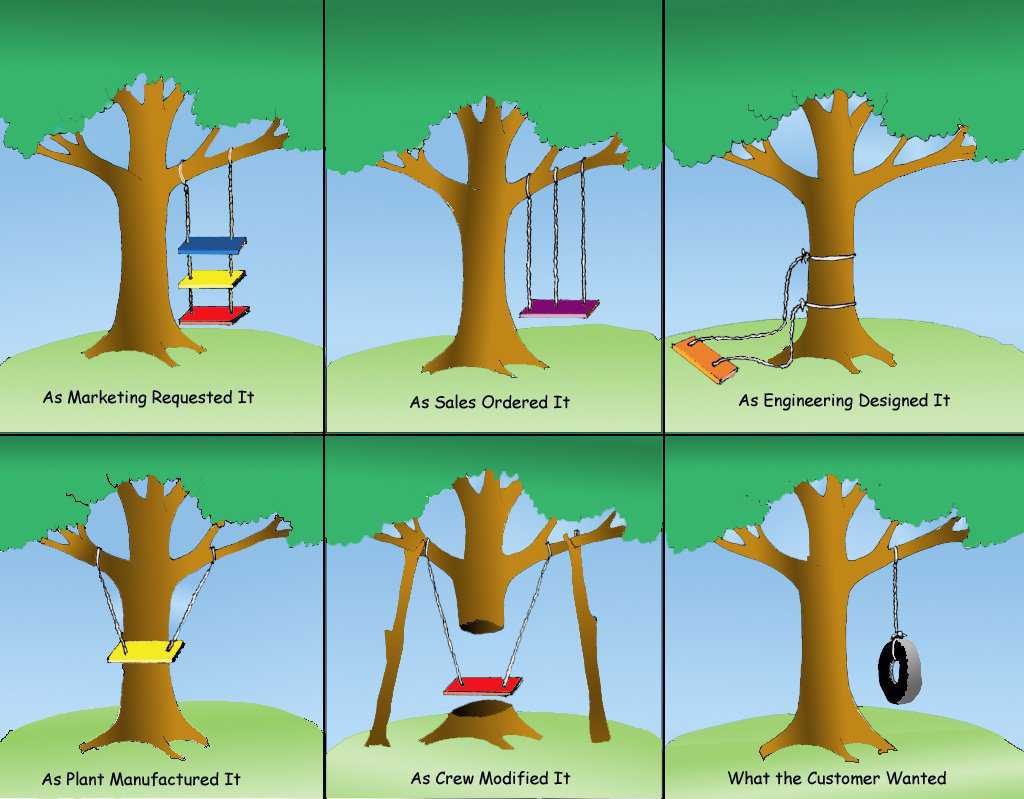
This is where low-code is pitched. In other words, it allows the users themselves to “build” an application.
Now obviously, no-code tools can’t completely abstract away all the lower-level complexities of software programming languages into a drag-and-drop interface and keep all the power of hard coding, but they can help go some of the way. The core concept behind no-code is designed to allow users to ask for what they want, and then sit back as the no-code platform builds it for them. So, it’s a case of what, not how.
Although it sounds completely nontechnical if we say, “what, not how,” this approach actually stems from declarative software programming theory.
Educational technologist Tyler McGinnis explains declarative programming in contrast to imperative programming in really simple terms as:
- An imperative approach (how): “I see that table located under the Gone Fishin’ sign is empty. My husband and I are going to walk over there and sit down.”
- A declarative approach (what): “Table for two, please.”
Low-Code Defined
So, no-code is all about software development automation at the most automated level. Low-code by contrast is meant for trained software engineering professionals. To be sure, low-code software programming still requires plenty of code, but it also builds in shortcuts and timesavers. Those shortcuts are presented in a library of tools that offer template-based structures to build code against and predefined routes to software integration.
In practice, low-code functions might include “mini-apps” or components of complete functionality that can be plugged directly into the code being developed. A calculator or currency converter function would be an illustrative (but technically too high level — we’re actually talking about deeper processing jobs) example. The idea is that there is no need to reinvent those wheels every time.
Alternatively, some low-code tools could be shortcut plug-ins to allow integration with entire third-party platforms such as IBM Watson for AI, Salesforce for CRM, or Tableau for visualization power, and so on.
SAP Low-Code No-Code
SAP isn’t a low-code or no-code company, because it doesn’t need to be. We can be reasonably sure that SAP will continue its database, analytics, and business functions road map throughout at least the start of the new decade without it tabling a dedicated new low-code no-code innovation. Instead, SAP works to champion its take on the intelligent enterprise with one of the usual suspects in the low-code marketplace: Mendix.
The Mendix Rapid Application Development (RAD) platform is intended to complement SAP solutions by providing organizations with the fastest and easiest way to develop applications that drive customer experience, employee engagement, and operational efficiency. According to Mendix, “[Our technology] is the only low-code development platform that natively runs on the SAP HANA data platform, taking advantage of in-memory database capabilities, advanced analytics, and unlimited scalability. And for Mendix, an SAP Solution Extension is the preferred development platform for SAP S/4HANA, SAP C/4HANA, SAP ECC, and SAP SuccessFactors solutions to build future-proof applications.”
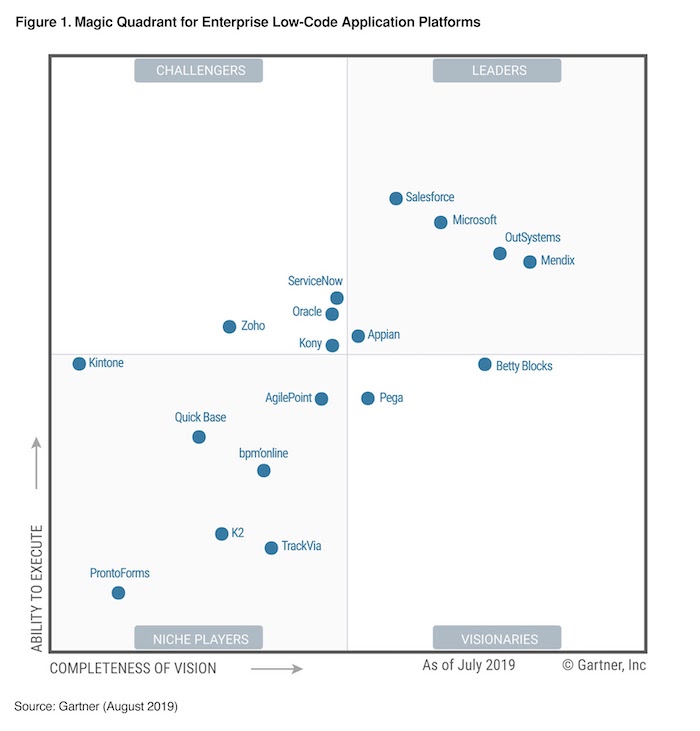
As a point of clarity on the low-code market, Gartner’s 2019 Magic Quadrant for Enterprise Low-Code Application Platforms shows Mendix alongside Salesforce (for Salesforce App Cloud) and Microsoft (for Microsoft PowerApps), both of which obviously aren’t pure-play low-code specialists. ServiceNow is also linked in this quadrant, but again the company is known for a wider platform play.
The arguably more pure-play low-code leaders are Mendix (low-code), Appian (low-code), Betty Blocks (no-code), OutSystems (low-code), and Zoho (low-code, but very simplified drag-and-drop). They are not on the Gartner quadrant but AppSheet, Airtable, and Nintex also deliver no-code solutions.
Hang on, What About SAP Web IDE?
Although we’ve said that SAP isn’t a low-code company, the caveat to that statement would be that SAP Web IDE is known as something of a low-code route to coding efficiency. The technology provides shortcut wizards, templates, samples, code, and graphical editors, as well as code modeler tools.
As SAP itself puts it, “SAP Web IDE is a powerful, extensible, web-based tool that simplifies both the development of end-to-end SAP Fiori apps and the full-stack (user interface, business logic, and database) application lifecycle. You can develop, debug, build, test, extend, and deploy role-based, consumer-grade apps.”
SAP Web IDE falls under SAP Cloud Platform and has been around for at least a couple of years. The company’s Milja Gillespie analyzes where it sits in the SAP Cloud technology offering here.
As we dive further into 2020, we will inevitably hear more about low-code and no-code as key routes to app-creation efficiency. We’ll need process controls and policy guidelines to ensure that business users don’t suddenly start “rolling out” apps that don’t help an organization’s data DNA to flourish, but that goes along with the change-management and governance required for any self-serve technology solution.
Looking to understand more about SAP Fiori? Register for our ASUG on-demand webcasts.
You Might Be Interested In

Log in to save this article and keep your favorite resources in one place.

Log in to save this article and keep your favorite resources in one place.

Log in to save this article and keep your favorite resources in one place.

Log in to save this article and keep your favorite resources in one place.